
By: Kendall Upton
Updated: February 3, 2026

If you’ve ever received a massage, you’re probably already familiar with at least a few different massage modalities. Massage modalities simply refer to different massage techniques or approaches. So if you’re thinking about becoming a massage therapist, which ones can you expect to learn in school? And can you learn modalities that aren’t a part of standard massage school curriculums? Let’s find out.
In This Article
What are massage modalities? | Modalities you learn in school | Program-specific modalities | Why they’re important | How to learn more
Many different cultures have practiced massage for millennia. It’s no wonder, therefore, that different massage techniques known as modalities have emerged over time.
“The origins of massage therapy originated in the East (primarily China and India and were brought west in the 1800s),” said Dana Ball, Owner and Director of the Carolina School of Bodywork in North Charleston, South Carolina.
In fact, the Associated Bodywork & Massage Professionals (ABMP) claim that their members practice over 350 different modalities of massage and bodywork. Of course, massage and bodywork professionals can’t possibly master every one of them.
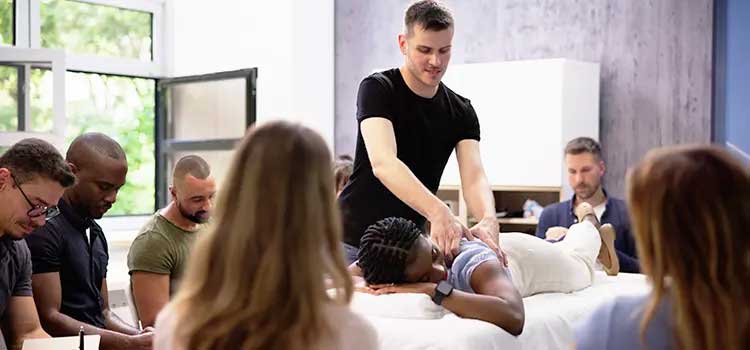
After learning about the human body’s anatomy and physiology and the foundational principles of massage, massage therapy students start to put that knowledge into practice. Most massage therapy schools teach several of the most popular massage modalities and may expose students to a couple of other techniques as well, but this depends on each program curriculum.
Once they’ve established their baseline skill set, massage therapists can take it upon themselves to learn about other modalities through continuing education courses, additional academic programs, apprenticeships and their own research.
Massage modalities that are commonly taught in massage school include:
“Swedish massage techniques are the first techniques taught often, and many modalities grew from Swedish or another traditional Chinese medicine technique like Tuina (sometimes spelled Tui Na),” Ball said.
Each program is going to vary in terms of which modalities they include and how much time they spend on them. Some massage therapy programs, for instance, might emphasize a more clinical framework that prioritizes pain relief and management, but still provide instruction in other techniques. Another program may focus on movement-based modalities, and others still may take a more holistic approach. It all just depends on the mission and goals of the school.
Many programs also touch upon hot stone therapy, cupping therapy and hydrotherapy, at least at a basic level. Since these are common add-on services that are relatively easy to learn, many programs introduce students to them in their curriculum.
“Students can also expect to be introduced to using water or hydrotherapy including heat and ice, minerals with water and their benefits, and therapeutic modalities such as myofascial release, reciprocal inhibition and other muscle energy techniques,” Ball said.
Some less common massage modalities are a bit harder to learn because they simply aren’t incorporated into most standard massage therapy program curriculums.
To learn some of these more niche modalities, most people must attend a smaller program dedicated only to that modality. Here are just a few examples:
Keep in mind that shorter, more specialized massage programs are often not enough to qualify for a general massage therapy license in your state. Always refer to your state’s licensing laws and check the program’s outcomes to be sure.
A firm grasp of at least several of the most common massage modalities is essential to get your massage career off the ground. But if you take the time to explore and master multiple modalities, you can respond to your clients’ needs with a greater breadth of solutions.
Even if you don’t want to offer a ton of different massage services, gaining exposure to different modalities can help you figure out which you like best.
“You don’t know what you don’t know,” Ball said. “There may be a facet of massage that students didn’t know existed until they were introduced to it. I very much enjoy trying to help each of my students find something that they are passionate about and help them get started down that path.”
After completing a massage program and getting your initial massage therapist license, it’s on you to continue learning and honing your skills.
“In many states, continued education is required to renew occupational licensure. The requirements would be documented in state massage therapy practice acts and the formats, if any, that each state accepts will be defined,” Ball said.
Indeed, you may have no choice but to take continuing education classes in order to maintain your massage therapist license. These are fantastic opportunities to learn about and practice new massage modalities.
“Most graduates are sent information regarding classes that are nearby, or see ads based upon marketing algorithms and social media. I encourage my students to remain curious, and never stop learning,” Ball said.
You can also search for continuing education opportunities through organizations like the ABMP or the American Massage Therapy Association (AMTA) and its state chapters.