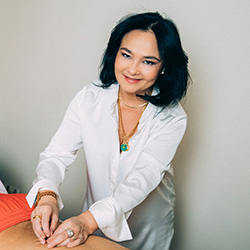
Learn how to become an acupuncturist in New Jersey
Acupuncture, a form of traditional Chinese medicine, is often used to treat pain by inserting thin needles through the skin at acupuncture points. It’s also a popular treatment for overall health and stress management. Acupuncture can be used to help relieve pain caused by many different conditions, including osteoarthritis, labor, headaches, fibromyalgia, dental pain and more.
Acupuncturists work in a variety of settings, including in private practices and in conjunction with medical offices. Given the growing interest in alternatives to traditional healthcare and medication, acupuncture is growing in popularity.
Becoming an acupuncturist in New Jersey can be a highly rewarding career, potentially allowing you to start your own practice and giving you the chance to improve the quality of life for your patients. To practice, acupuncturists must be licensed in their state, and each state has its own licensing requirements. If you’re considering becoming an acupuncturist in New Jersey, read on to find out about the requirements so you can plan your education path to this exciting career.
Requirements for becoming an acupuncturist in New Jersey
The New Jersey Acupuncture Examining Board, which is supervised by the State Board of Medical Examiners, regulates acupuncturists and trainees and supervises acupuncturist training programs within the state.
Education and training requirements for NJ
According to N.J. Admin. Code 13:35-9.4, to qualify for acupuncture licensure in New Jersey, an applicant must earn a baccalaureate degree from a school in the United States. They must also graduate from an acupuncture program that is accredited by the Accreditation Commission for Acupuncture and Oriental Medicine, the Commission on Recognition of Post-Secondary Accreditation or the United States Department of Education. The program must consist of at least 2,500 hours of instruction, and the school must submit a certified transcript to the Board.
Once students have completed their education, they must take and pass the NCCAOM examination to become a NCCAOM Board-Certified acupuncturist. To take the exam, applicants must:
Submit an online application
Submit their final graduation transcript
Submit a clean needle technique certificate
Receive a NCCAOM Authorization to Test letter
Take all required Board exams
While NCCAOM Board Certification isn’t required to become a licensed acupuncturist in New Jersey, it can be helpful to get certified, especially if you anticipate ever moving to or practicing in a state that does require certification. New Jersey does require NCCAOM to practice herbology.
Tsao-Lin Moy, L.Ac., MSOM, an acupuncturist and Chinese Medicine practitioner and fertility specialist, founded Integrative Healing Arts in New York City. She taught acupuncture in New York City and New Jersey for more than 17 years. Moy explains that an accredited acupuncture college will provide review courses to help prepare students to pass the board exams. “All board examinations look at the minimum required knowledge to practice safely and within the scope of practice, so studying complex treatments and points will not help to pass the exams,” says Moy. Students can take the NCCAOM exam in Chinese, Korean or English.
An accredited acupuncture college will provide review courses to help prepare students to pass the board exams.
New Jersey license applicants must take the New Jersey Acupuncture Safety and Jurisprudence Examination, as required by the Acupuncture Examining Board. To take the examination, students must have met the education requirements and gain Board approval.
The examination consists of 50 multiple choice questions focusing on topics like acupuncture safety, including needling safety, infection control and contraindications to acupuncture treatment. Questions also cover acupuncture laws and regulations in New Jersey. The examination is delivered online, and applicants must answer all of the questions in a single session.
Having passed the examination, students can apply to become a licensed acupuncturist in New Jersey online. The application costs $100, and applicants must submit:
A passport-sized photo
A copy of their birth certificate
Proof of citizenship (if necessary)
Official undergraduate and graduate transcripts
Translation of transcripts (if necessary)
Evaluation of foreign education credentials (if necessary)
NCCAOM Examination transcripts
New Jersey continuing education requirements
Once acupuncturists are licensed in New Jersey, they must re-certify every two years to maintain their license. Acupuncturists must complete specific continuing education requirements to apply for re-certification:
30 continuing education units across a period of 2 years
15 continuing education units must be from live trainings
Up to 15 continuing education units may be from distance learning
“The NCCAOM has lists of approved courses and providers where practitioners can complete their continuing education credits that are also recognized by the stat licensing,” explains Moy. Additionally, local acupuncture associations may also sponsor continuing education courses. “Many acupuncture and herbal suppliers offer continuing education courses for their patrons,” says Moy. “Acupuncture Continuing Education has online CEU course and packages that are easy to take, and has lists of courses for specific state requirements.”
Legal considerations for acupuncturists in New Jersey
Transferability: Out-of-state acupuncturists
According to NJ Admin. Code 13:35-9.4, acupuncturists who have received their education or licensure from other countries must prove that their education qualifies them for New Jersey licensure. They must have a transcript evaluating company that is recognized by NCCAOM submit a credential evaluation directly to the Board when they apply for their license.
Professional conduct and ethical guidelines
The NCCAOM Code of Ethics outlines the standards for the acupuncturist profession. Among others, they include:
Respect the rights, privacy and dignity of my patients by maintaining confidentiality and professional boundaries at all time
Respect my colleagues, employees, students and mentees by maintaining appropriate boundaries
Render the highest quality of care and make timely referrals to other health care professionals as may be appropriate
Continue to advance my knowledge through education, training and collaboration with my colleagues
Participate in activities that contribute to the betterment and wellness of my committee
Scope of practice
NJ Admin. Code 13:35-9.12 states, “The use of any of the following to effect the stimulation of acupuncture points and channels is within the scope of practice of licensed acupuncturists and shall be permitted only by acupuncturists licensed by the Board, individuals permitted to practice pursuant to NJSA 45:2C-8, students in acupuncture programs that meet the requirements of NJAC 13:35-9.49(e), or guest acupuncturists permitted to perform acupuncture in New Jersey pursuant to NJAC 13:35-9.13:
Needles
Moxibustion
Teishin (pressure needles)
Electroacupuncture
Insurance and liability
New Jersey law requires licensed acupuncturists to carry medical malpractice insurance for at least $1 million per occurrence and $3 million per policy year. Moy explains that the American Acupuncture Council and CM&F group offer malpractice insurance with a liability insurance rider.
Working as an acupuncturist in New Jersey
How much do acupuncturists make in New Jersey?
While the U.S. Bureau of Labor Statistics (BLS) doesn’t have acupuncturist salary data specific to all individual states, the BLS reports that as of 2023, acupuncturists made a median annual wage of $76,040, with the top 90% making $161,470 and the lowest 10% making $38,830. Wages varied depending on industry, too, with acupuncturists working in colleges, universities and outpatient care centers making some of the highest wages. Acupuncturists who worked in the offices of other health practitioners made some of the lower wages.
Here’s BLS data for acupuncturists in New Jersey:
Acupuncturists
10%$73,110
25%$108,370
50%$125,260Median
75%$140,540
90%$187,360
Median Hourly Wage$60
Job growth8.6%
Total Employment240
Metro area
Median Salary
Bottom 10%
Top 10%
Source: U.S. Bureau of Labor Statistics (BLS) 2025 median salary; projected job growth through 2035. Actual salaries vary depending on location, level of education, years of experience, work environment, and other factors. Salaries may differ even more for those who are self-employed or work part time.
Moy recommends that acupuncture students start investigating any employment opportunities that may be listed with their acupuncture school before they graduate. “Deciding what area the graduate would like to focus on will also guide them towards where to look for opportunities,” she says. “Interning is also a way to get experience and possibly be hired by another practitioner to start.”
She notes that many graduates start by working part-time in community clinics, which gives them a chance to gain hands-on experience. This type of work arrangement can potentially help acupuncturists to become a provider under some health insurance benefits.
“This is the “tricky” part of the profession,” says Moy. “It is not like other health professions such as nursing or physical therapy where there are jobs, and they are within a Western healthcare model that is insurance-driven.”
Setting up a private practice in New Jersey
To establish a private practice, acupuncturists will need to obtain a small business license. The requirements for obtaining a license vary depending on your state and town, so it’s best to talk to your town administrators to find out the exact steps that you will need to take.
Moy highlights the importance of acupuncturists having an entrepreneurial and service mindset for going into business, such as by starting a private practice. “There is a big learning curve, but if you love what you do, it is rewarding,” she says.
“We are helping people learn about their internal wisdom, and self-healing works best when patients take an active role in their wellbeing.”
She notes that acupuncture and Chinese medicine are holistic models of health. “Don’t get caught in the broken and fix mentality and forget to educate the patients on how they can improve no matter what,” she says. “We are helping people learn about their internal wisdom, and self-healing works best when patients take an active role in their wellbeing.”
Staying up to date on industry developments and trends
Several state and national organizations can help acupuncturists in New Jersey stay updated on industry developments and trends.
The New Jersey Acupuncture Society maintains a job database, a database of acupuncturists within the state and a series of lectures and webinars for acupuncturists.
Becoming an acupuncturist can be a highly rewarding career. Acupuncturists interact with and help patients daily, offering alternatives to traditional healthcare routes such as surgery and medication. Acupuncturists can work in many different settings, including potentially starting their own private practice and launching a successful career.
The first step to becoming an acupuncturist in New Jersey is to receive education and training. That starts with earning a bachelor’s degree, and then pursuing a master’s degree in acupuncture. If you’re thinking of pursuing an acupuncture career, then start by researching bachelor’s degree programs and accredited acupuncture programs that can help to start you on your path.
How to become an acupuncturist in your state
As you know, in most states, you need certification to earn licensure to become an acupuncturist. Here are in-depth explorations of what you’ll need to do in some key states: